
Newsletter: Vol. 2
Might I have a word with you?
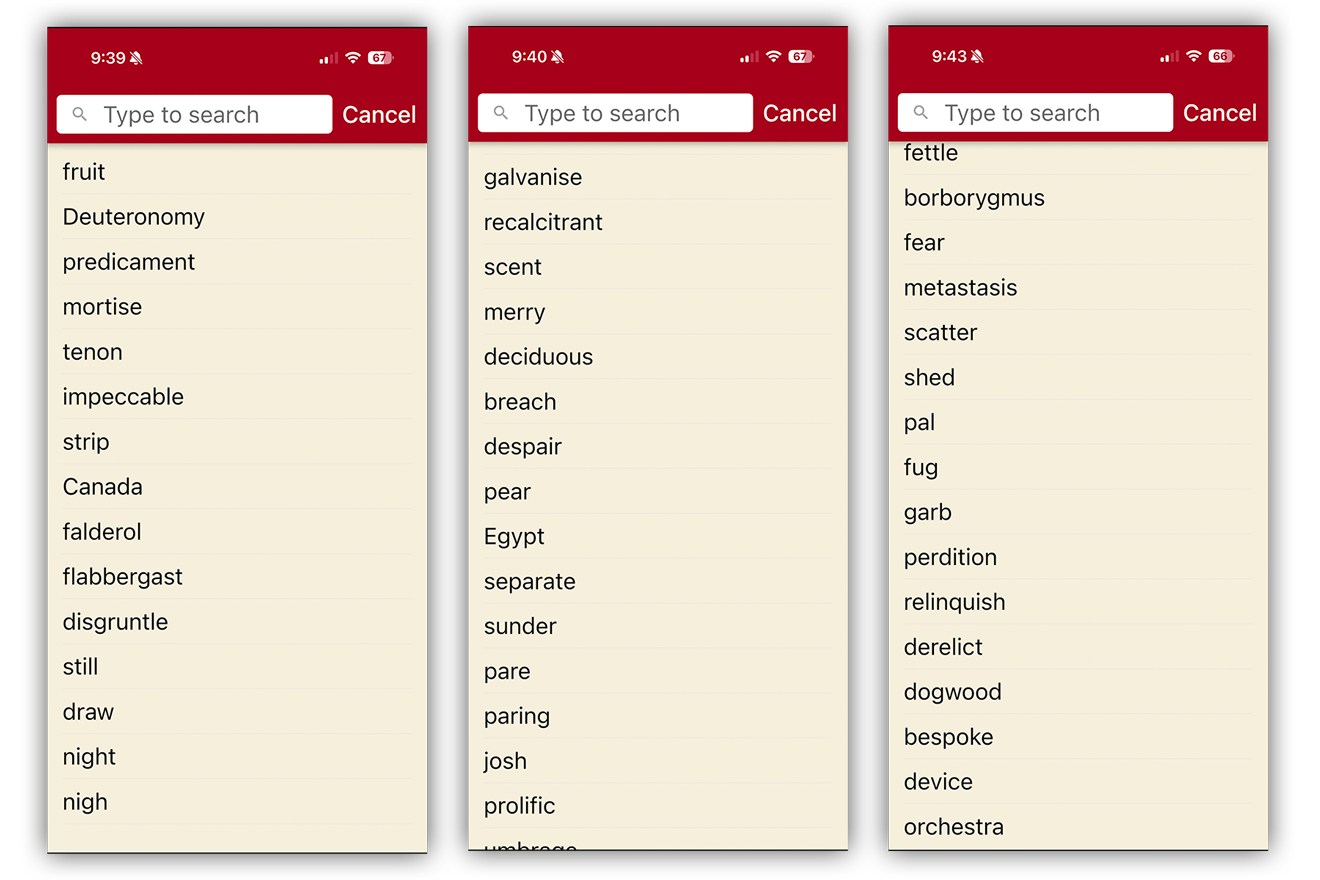
Or maybe a few. Much of my writing has been inspired by diving into word origins and learning about the ways meanings have shifted over the years. My go-to source is Etymonline (usually the mobile app). The app keeps a history of words I’ve researched. It might be a little too revealing, but here’s a sampling, ranging from the mundane “still” to the obscure “borborygmus” (we have James Herriot to thank for that one).
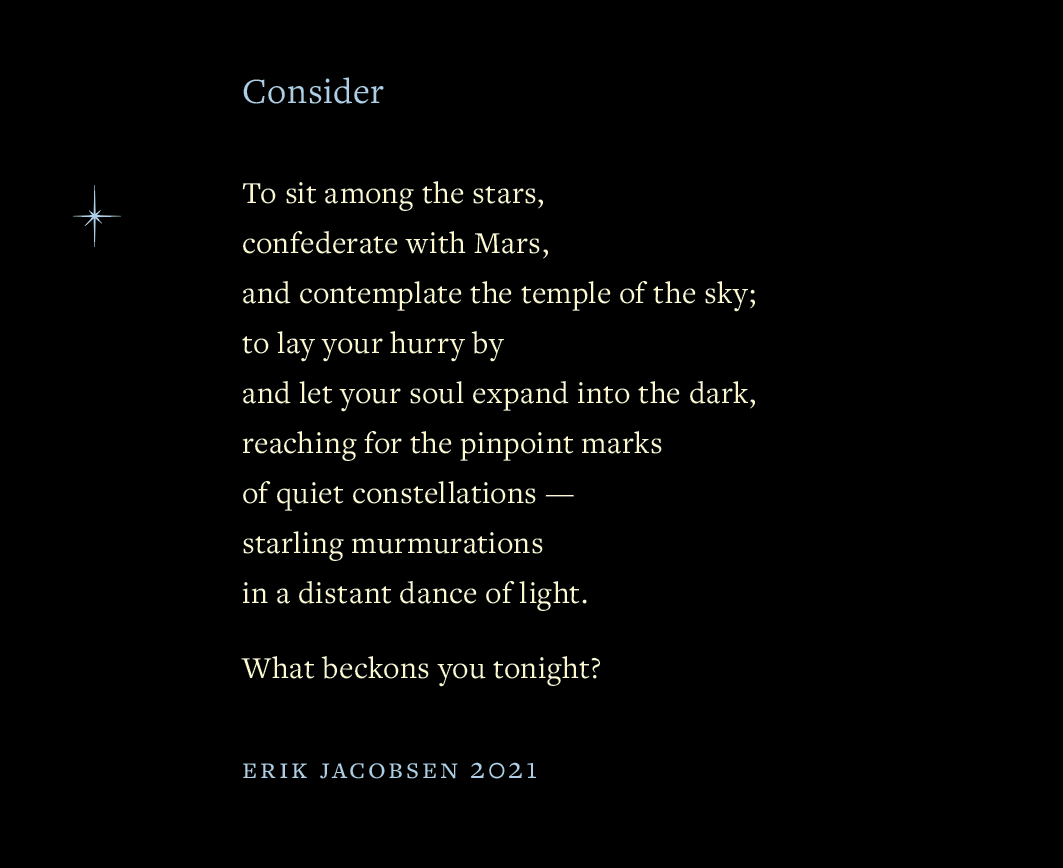
One of my etymological explorations led to the poem “Consider” – the word’s source is Latin, to quote from Etymonline: “probably literally ‘to observe the stars,’ from … com ‘with, together’ (see con-) + sidus (genitive sideris) ‘heavenly body, star, constellation’ (see sidereal).”
The poem first appeared in a starry family Christmas card of ours a few years ago.
There’s a rich complexity in even the simplest word – layers of connection to other times and tongues. Tapping into that history teaches me new things and gives me a deeper appreciation of this amazing language of ours. I wonder how much of that latent historical meaning rests quietly in our subconscious. Has anyone tried to answer that question?
The History of English: A quick plug
Knowing my love of words, a friend turned me on to the podcast from Kevin Stroud, The History of English. It starts all the way back at Proto-Indo-European, the ancestor of English. I confess to having listened to each of the almost 200 episodes (that’s probably over 200 hours total). My appreciation for the layering of the language has been greatly enhanced by Kevin’s excellent exploration of English and its many influences.
Simple complexity :: Complex simplicity
Thinking of the rich complexity in a single simple word leads me to this: I was working on a presentation for a client recently that sent me on a research project chasing the origin of a quote I’ve heard many times before, usually attributed to U.S. Supreme Court Justice, Oliver Wendell Holmes Jr…
“For the simplicity on this side of complexity, I wouldn't give you a fig. But for the simplicity on the other side of complexity, for that I would give you anything I have.”
I think of simple simplicity on the near side of complexity as flatness, ignorance, the Garden of Eden. Complexity itself is chaos, struggle, uncertainty, messy experience. And then there is a simplicity won only by passing through the chaos and struggle and the weathering of time. That complex simplicity makes me think of things held in beautiful harmonic tension, of understanding, wholeness, community, love. The richness of a piece of driftwood shaped by decades of rough contact with ocean and sand. That concept resonates deeply – I’d give at least a fig for that.
Well, I could find no evidence that Holmes Jr. ever actually said those words. Quote Investigator, often a trusty source for quote origins, had nothing for me, so I felt compelled to track it down myself. Here’s what I found, in a 1902 letter to Lady Pollock:
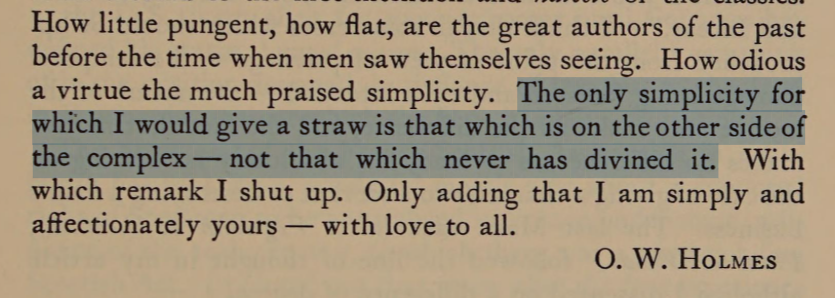
Oliver Wendell Holmes Jr. Holmes Pollock Letters (from Internet Archive)
Instead of withholding a fig, he’s offering a straw. I think I’d rather have a fig, and arguably, the commonly quoted version is simpler to grasp than this, more pungent version; we don’t use “divine” as a verb much these days. Does that make this one richer? Or has the common version achieved the simplicity on the far side of complexity from having passed through various interpreters along the way? What’s your take?
In my journeyings, I found a very similar quote to the misquoted original, this time attributed to Alfred North Whitehead. But it appears he never actually said that one either. His actual gem was “Seek simplicity and distrust it.”
And there was a concise (and confirmed) statement from Winston Churchill: “Out of intense complexities intense simplicities emerge.”
Maybe we should create a portmanteau that captures complex simplicity in one term. We could weave them together into complicity.
With which remark, like O.W. Holmes, I shut up.
On pungent sourdough
In an article that originally appeared in the Washington Post (non-paywall version here), Melissa Wei-Tsing Inouye compared religious tradition to sourdough bread with its complex flavors and simple ingredients. To quote from the article:
“There is nothing lovely or pure about sourdough starter. Its exuberance makes it sour on the verge of stinky, fermented bordering on decayed. Yet, when introduced into a properly balanced supply of flour, water and salt, the starter is a catalyst for building a complex, living community that results in heavenly bread.”
I’ve been baking sourdough for a few years, using a starter born in the 1970s. I had just baked a couple of loaves when Melissa unexpectedly came to stay with us for a night. She was exploring a possible clinical trial to stave off the cancer that would finally claim her life a month later. Watching her savor a few bites of that bread was unforgettable and inspiring – full-bodied, open-hearted, complete enjoyment with all her senses focused on the morsel in her mouth.
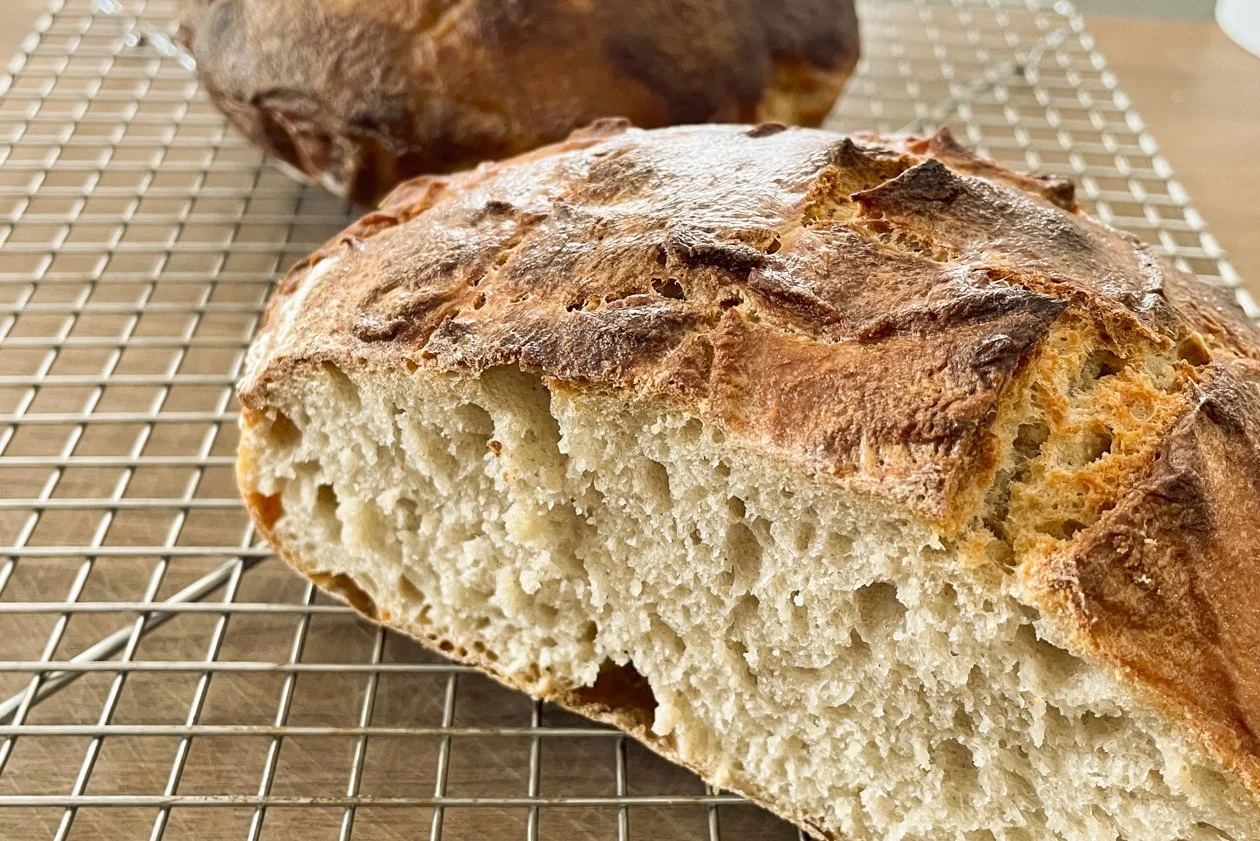
The loaf that Melissa savored
When I heard she had died, I tried to capture the experience in a poem. It’s not particularly polished, and I probably won’t ever publish it, but if you’d like to see it, send me a note and I’ll consider forwarding it to you.
Thanks!
Thanks to you for reading this, and to the many of you who have read and responded to The Gift of Broken Things. I’m grateful for the personal expressions in the personal cards and messages you' have sent.
Also, I’m sharing occasional poems and photos and thoughts somewhat regularly on Instagram. Follow Threestory Press on Instagram.